

The Commercial Leasing Market in Canada
If you are planning to lease commercial space, whether in major Canadian hubs like Toronto, Mississauga, and Calgary, or across British Columbia in Vancouver, Surrey, Burnaby, Langley, Victoria, and Kelowna: you may be navigating a fast-moving, location-driven real estate market.
Understanding regional market trends can give founders essential leverage when negotiating lease rates, tenant incentives, and key lease agreement terms. Here is my overview of what the commercial leasing landscape looks like across these key Canadian cities.
1. The Storefront Space Crunch
If your business needs a ground-floor retail location or storefront, a boutique salon, wellness clinic, studio, or retail shop, then prepare for competition. These spaces generally are in high-demand and come at a premium cost.
Ultra-Low Vacancy in Urban Hubs: Retail vacancy across Vancouver, Toronto, Victoria, and Surrey sits at historical low levels (routinely under 3% for high-street retail, and under 1% for grocery-anchored plazas).
Rapidly Growing Suburban Hubs: Fast-growing municipalities like Surrey, Langley, and Mississauga have seen considerable population inflows. High-demand retail strips in these areas rarely sit empty for long.
Property Owner Leverage: Landlords in certain prime areas of Vancouver, Toronto, and Kelowna hold significant leverage. They can afford to be selective about tenant credit and are less likely to offer steep base-rent discounts.
The Founder's Play: If you need a prime storefront, prepare a polished corporate deck and financial package upfront. Showing landlords you are a low-risk, established brand makes your offer stand out in a tight market. If you’re looking for more affordable options, flexibility with location is key.
2. The Additional Rent Shift
While Base Rent gets most of the attention, Additional Rent (Triple Net / NNN / TMI) is where many business owners get blindsided.
TMI/NNN Reality: Driven by rising municipal property taxes, building insurance, and utility costs, Additional Rent in major cities like Toronto, Mississauga, Vancouver, and Burnaby can range from $15 to $30+ per square foot.
Percentage of Total Rent:(Spoiler alert: "Base Rent" is lying to you.) In prime spots in Vancouver or Downtown Toronto, Additional Rent can account for 40% to 50% of your total monthly rent cheque.
Secondary Market Compression: In markets like Kelowna and Victoria, or expanding suburban nodes like Langley, rising operational costs mean Additional Rent can add $10 to $18/sq ft on top of base rent.
The CEO Reality Check: Always look closely at the Additional Rent numbers before signing an Offer to Lease and be sure to budget accordingly.
3. The Office Market Divide
Unlike retail space, the office sector across Canada presents a split story depending on the city and building class.
The Calgary Opportunity: Calgary is a unique office market. Downtown office vacancy remains elevated, however, suburban office space in Calgary sits significantly tighter.
Toronto, Mississauga & Vancouver: Downtown core Class-A "trophy" buildings in Toronto and Vancouver remain in high demand. However, suburban office parks and Class-B/C spaces in Mississauga, Burnaby, and Surrey have higher vacancy rates.
Tenant Negotiation Power: Business owners looking for office, therapy, or agency space in Class-B or C buildings may have some solid bargaining power. Landlords in these buildings may be more willing to offer Tenant Improvement (TI) allowances (cash toward your buildout) or free rent periods to lock in long-term tenants.
4. Construction & Buildout Costs
If you are leasing a "shell" space or a location that requires significant custom renovations (like specialized plumbing for salons, soundproofing for clinics, or floor-reinforcement for gyms), budget carefully.
Renovation Inflation: Commercial interior buildout costs in British Columbia and Ontario average $150 to $250+ per square foot.
Securing Incentives: Since buildout costs are high, negotiating a strong Tenant Improvement Allowance or securing a Fixturing Period (a period of zero rent while you complete construction before opening) may be necessary.
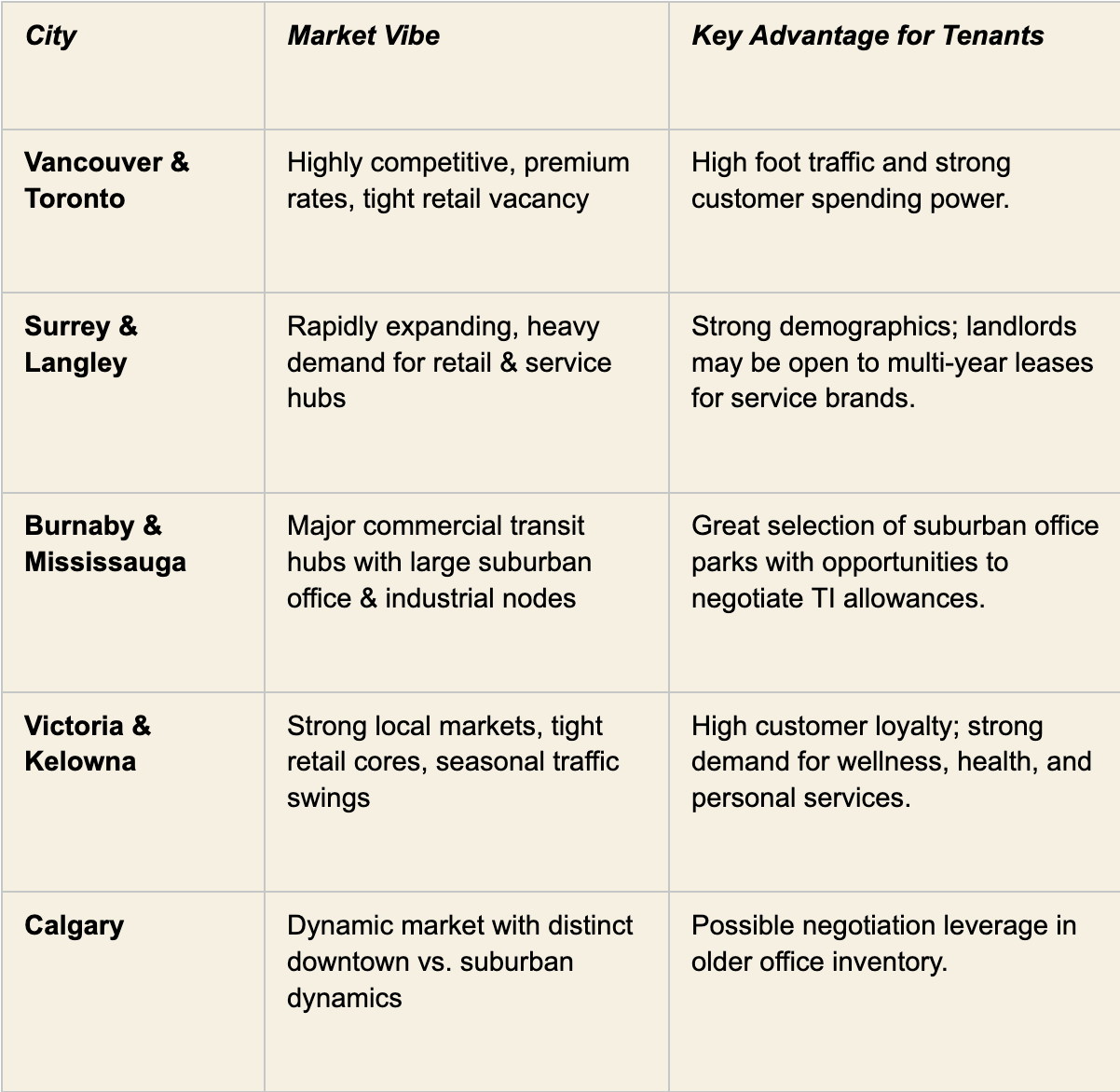
Snapshot: City-by-City Guide
Navigating Today's Market
Start Early: Give yourself 6 to 12 months before your target opening date to find space, negotiate terms, and complete buildouts.
Factor in Inflation: Budget for Additional Rent to increase by 3%–5% annually over your lease term.
Use Market Leverage: Work with a qualified broker or commercial real estate agent or borker to learn about your leasing markets.
In summary, consider this your official permission to be high-maintenance about the market numbers, your future cash flow will thank you.
Need a Partner to Navigate Your Commercial Lease?
You shouldn't have to decipher complex indemnities, triple-net calculations, or demolition clauses alone.
Encino Law supports women founders, service business owners, and entrepreneurs through the commercial leasing process.
Before you sign on the dotted line, let’s make sure your lease is built to protect your business. Book a Commercial Lease Review Session
Disclaimer: Market conditions fluctuate. This post provides general and aggregated educational information regarding commercial real estate trends across Canadian markets.
